Within the high-stakes world of modern serious sliding, victory is no longer purely a product of sheer horsepower or driver courage. Instead, it has become a intricate science that necessitates a painstaking fusion of choosing a inherently capable vehicle platform, equipping it with the correct competition components, and, most importantly, comprehending its live performance on the circuit through sophisticated vehicle dynamics analysis tools. This comprehensive guide functions as your roadmap from the very first idea of a project car all the way to the last engineering-refined adjustments that transform a strong machine into a repeatable podium finisher. We will thoroughly explore the art and science of vehicle alignment optimization, illustrating how a state-of-the-art drift tuning app like precise measurement hardware removes approximation and delivers unparalleled clarity into your car's true dynamics.
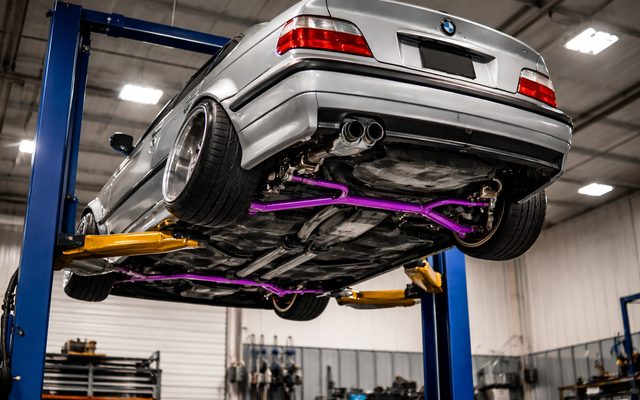
The foundation of any great competitive sliding vehicle is, undoubtedly, the base vehicle itself. A select group of platforms have earned legendary standing within the global sliding culture due to their natural handling characteristics, strong construction, and the immense ecosystem of performance components available. Choosing the optimal car is the initial and most important choice a driver will make. For instance, the the E36 generation BMW is widely regarded as among the greatest overall cars for drifting of all time. Its excellent balanced front-to-rear weight, combined with a driven rear axle layout and extremely reliable inline-six powerplants, creates a car that is simultaneously easy to handle for novices and incredibly competitive in the possession of a expert competitor. The evolution of this concept, the BMW E46 platform, improves on these strengths with a even more developed chassis, increased stance for greater confidence, and yet a greater degree of turning capability directly from the factory. A different powerful platform in the professional scene is the C6 generation Corvette.
This V8-powered performance car brings a unique set of strengths to the drifting world, such as a light aluminum structure, a rear-mounted gearbox and differential unit that aids in an ideal balance, and the tremendous low-end power of a large-displacement LS V8 motor. This combination transforms it into an utter monster on track, able of initiating and sustaining extended angles with seemingly minimal application of throttle. For drivers looking for remarkable bang-for-the-buck, the Nissan 350Z stands out as a top-tier example. It arrives from the factory with a robust chassis, a decent OEM locking differential, and the free-revving V6 motor that provides plenty of horsepower and torque for practicing and progressing in the sport. Its newer version, the Nissan 370Z, presents further refinements in body strength, handling precision, and peak engine output, solidifying its position as a popular selection among competitive drivers. Further historic vehicles that warrant attention are the agile unique Mazda FC, the most popular Nissan S13 240SX, the torque-rich Ford Mustang SN95, the electronic-equipped BMW E90, and the small yet surprisingly playful and forgiving Mazda MX-5. Each of these platforms provides a unique array of traits, complexities, and possibilities, but they all have in common the core elements necessary to be transformed into a competitive drift car.
However, selecting the right platform is just the first step. To release the true performance of every of these cars, significant changes to the steering geometry and damping and springing systems are absolutely non-negotiable. This is where the world of specialist aftermarket hardware enters critical view. The single most impactful modification for a purpose-built drift machine is the installation of a drift-spec angle modification kit. These advanced kits, such as those manufactured by specialist companies like SLR, are designed to significantly increase the chassis's available steering angle. A standard production vehicle is extremely constrained in how far its front wheels can pivot, a design trade-off for daily driving. In oversteer driving, however, maximum countersteering is continuously needed to catch and hold a angle. An steering kit exchanges the stock hubs, tie rods, and potentially control arms with parts that enable the steered wheels to achieve steering lock over 70 or even 80 degrees, versus a normal factory angle of around 40 to 50 degs.
This vastly greater lock gives the pilot with exponentially more authority during a slide, making it considerably simpler to start a oversteer moment, sustain it through a long turn, and change seamlessly from one direction to the opposite. The difference in handling is nothing short of transformative. Combined with a properly chosen modification is the every bit as critical enhancement to the car's damping system. Store-bought or even premium sport coilovers are simply not engineered for the specific and harsh requirements of sliding. A purpose-built pair of suspension units is paramount. These specialized dampers incorporate specific piston tuning and spring stiffness that are designed for the rapid mass transition that is characteristic of sliding. When a pilot begins a drift, the chassis's weight is transferred violently to the outside of the corner. Proper drift-spec coilovers control this transfer in a predictable fashion, enabling the chassis to settle promptly and offering the pilot clear feedback through the steering wheel and cockpit. They furthermore provide exact tuning of ground clearance, shock absorber rate, and weight balance, which are all key parts of optimizing the car's handling to a given venue or piloting style. Together, a top-tier angle modification system and a properly specified system of drift-spec adjustable dampers constitute the core mechanical cornerstone upon which all later refinement is constructed.
Once the essential components is fitted, the next essential phase in the project is the precise setting of the vehicle's wheel angles. This is the realm of chassis dynamics adjustment, a procedure that can feel daunting to the newcomer but is, in reality, the secret to turning a collection of capable parts into a harmonious and predictable vehicle. The most critical aspect of suspension geometry for oversteer is undoubtedly camber angle. Camber is the tilt of the rim relative to the vertical plane when observed from the forward of the vehicle. When the upper part of the wheel is leaning towards the chassis, this is called negative camber. For drifting, inward-leaning wheels on the front tires is widely employed and is seen as essential. The purpose is deeply related to tire contact.
When a car is cornering at limit slip angles, the frame tilts towards the outside of the corner. This chassis roll makes the outside front tire to reduce its ideal grip area with the asphalt. By applying inward lean, the wheel is pre-leaned to account for this lean. As the chassis tilts into the turn, the outside front tire becomes more upright with the track, increasing its traction at the critical moment when it is absolutely essential for steering authority. Usually, front angles for a serious sliding vehicle range from approximately -3 degrees to as high as -5 degrees or even beyond, contingent on the parameters of the chassis configuration, rubber selection, and driver preference. The rear axle tires also employ negative camber, but the angles are typically less and subtler than the front axle. Too much inward lean at the rear can make the car extremely prone to oversteer and challenging to control on throttle application, as it diminishes the usable tire footprint of the driven wheels during forward acceleration. Thus, rear axle camber settings are frequently in the range of -1 degree to -3 degrees, finding a precise balance between offering adequate cornering bite to aid in initiating and maintaining the angle while also keeping effective traction for acceleration the bend. Camber is only one element of the larger alignment equation, which furthermore includes toe setting, self-centering steering, and suspension-induced steering modification.
Toe refers to the orientation of the wheels when viewed from a bird's-eye view. Positive toe means the front edges of the tires are closer together than the trailing edges, while drift telemetry software toe-out means the reverse. For oversteer, a small amount of front negative toe is often employed to improve the turn-in directional feel, making the chassis feel more responsive and eager to initiate a slide. Rear toe setting is typically set to zero or a extremely small amount of inward toe to foster straight-line stability under throttle. self-centering is the longitudinal or aft tilt of the steering axis when viewed from the side of the vehicle. More caster improves self-centering and high-velocity confidence, and it additionally increases negative camber drift telemetry software gain during steering, which is extremely advantageous. Tuning these parameters is a complex dance where a adjustment to one setting can and often will impact the other settings. The traditional process for tuning a car's alignment for competition has for a long time been a tedious affair of trial and error. A tuner or crew would make a modification based on intuition, drive the chassis on track, use the operator's personal feel and impressions, and then apply an additional change. This cycle would continue over and over until the chassis felt "good" or the scheduled track period ran out. This system is not only exceptionally wasteful in terms of time and costs, but it is also deeply imprecise.
Driver sensation is a infamously subjective data source, affected by countless variables such as exhaustion, changing track surfaces, temperature, and just the focus of the driver on that specific run. What feels "loose" on one lap might feel "understeery" on the subsequent lap, resulting in contradictory feedback and counterproductive adjustments. This long-standing limitation in car suspension tuning is exactly where state-of-the-art telemetry systems has stepped in to completely change the methodology.
The development and application of advanced vehicle dynamics tools has introduced a radically different era for building and optimizing high-performance drift machines. This new generation of platforms, showcased by cutting-edge systems like GripDial, function by directly capturing the actual dynamic performance of the chassis as it is piloted on the course. As opposed to using personal impression, these systems collect measurable metrics on essential variables such as damper compression and extension, wheel speed, G-force loading, lock position, and throttle and brake application. This raw information flow is then analyzed by sophisticated applications that can visualize and interpret the data in a actionable way. For the very first time, engineers and teams can visualize precisely what the vehicle is doing at each moment of a slide. This capability revolutionizes the whole suspension tuning workflow. Think about the specific goal of optimizing the front negative camber for a specific car. As an alternative to making a modification from -3 degrees to -3.5 degrees and then testing multiple passes to try and "perceive" a change, a suspension tuning tool can deliver immediate and definitive feedback. The tool can display in a chart how the wheel's loading is performing during the key phases of a angle: initiation, holding the angle, and transition. It can reveal if the current value is permitting the outside front tire to maintain optimal loading or if the rubber is working inefficiently on its outer shoulder.
The system can subsequently make empirical advice for change. Perhaps the information shows that the outside front tire is even overloading its edge at -3.5 degrees of negative camber, suggesting that a move towards negative camber, say -4 degrees, might be advantageous. Alternatively, the data might reveal that the tread is not achieving heat or that the inside shoulder is degrading excessively, which could indicate that there is overly aggressive negative camber and a small decrease back to -3.2 degrees would be more ideal. This standard of granularity and useful insight was literally unattainable in the era of pure manual tuning.
The effect of utilizing a dedicated vehicle dynamics tool reaches far beyond merely setting alignment. It functions as an essential coilover setup tips that is specific to your specific vehicle. When adjusting the damping values on your adjustable dampers, rather than depending on imprecise advice or copying another car's settings, you can use the software to observe how the chassis is reacting in relation to your adjustments. The tool can graph the suspension travel data over a section of track, showing if the coilovers are controlling the chassis motion effectively or if they are permitting the vehicle to bounce too much after a flick. It can aid in pinpointing challenges like bottoming out or topping out, permitting you to introduce data-backed choices to preload settings, damping rates, or ride height. This approach translates equally to the detailed process of suspension geometry optimization. Beyond camber angle, the tool can give analysis into how adjustments to toe and caster are impacting the vehicle's handling during various phases of a drift. For instance, it can assist you to ascertain the best amount of front axle toe out for your particular steering setup and competition technique by showing the quickness of initial response and the stability of the car at lock lock. This transforms the system an extremely useful vehicle dynamics manual that is dynamically informed by the live performance of your personal vehicle on the tarmac. It shifts the complete endeavor from a subjective skill into a methodical development exercise.
Moreover, the application of a tool like data acquisition is not restricted to professional engineers with extensive budgets. For the grassroots enthusiast, it functions as an powerful force multiplier. It effectively gives the tuner with the analysis of a expert race engineer without needing the corresponding expense. It drastically shortens the learning curve by providing clear answers to questions that would traditionally take years of trial and error to answer. A builder can understand how their particular car reacts to various adjustments, developing a more profound comprehension of car control in the endeavor. It additionally democratizes high-level chassis dynamics concepts, allowing anyone with the drive to perfect their car to do so in a structured and effective fashion. This is particularly significant in a activity like oversteer competition, where engineering expertise has historically been a closely guarded advantage among professional crews. Now, that knowledge can be in the garage of every motivated builder.
In summary, the journey to building and tuning the ideal high-performance sliding vehicle is a multi-faceted endeavor that smoothly integrates classic engineering wisdom with cutting-edge telemetry tools. It commences with the wise selection of a legendary chassis, then built upon the integration of non-negotiable drift-spec components like maximum-angle angle modification systems and properly selected drift-spec suspension units. The process then moves into the detailed phase of car suspension tuning, where values like camber, toe, and caster angle are meticulously set to complement the vehicle's modified capabilities and the pilot's personal style. Ultimately, and what really separates the contemporary process from the old ways, is the use of a sophisticated vehicle dynamics tool. This platform removes the uncertainty and trial and error of purely feel-based adjustment by delivering quantifiable, live data on how the car is really performing. It acts as an unparalleled engineering partner, a comprehensive coilover setup manual, and a all-in-one vehicle dynamics tool. In unison, this integrated philosophy leads to that all car suspension tuning aspect of the drift car—from the selection of the chassis to the final click on the damper—is optimized for maximum performance on the track. It represents the full progression of the art of oversteer driving, connecting mechanical pilot talent with surgical chassis dynamics to build the most effective machines attainable.